Modifier 25: when to use it in primary care (2026)
Add modifier 25 to the office visit code, like 99213-25, when the clinician handles a separate, significant problem on the same day as a procedure or a wellness visit. The visit must stand on its own. It can share a diagnosis with the procedure. But deciding to do a minor procedure is already part of the procedure.
How we made this: Kate wrote this with AI help from the AMA's modifier 25 guidance, the CMS NCCI policy manual, the Medicare claims manual and the 2026 Medicare fee schedule file. All four worked examples were run through Jentii's free checker on October 28, 2026, and the results are shown as they came out.
What is modifier 25? #
Modifier 25 is a two-digit tag you add to an evaluation and management (E/M) code, like an office visit. It tells the payer the visit was real, separate work done on the same day as a procedure or other service, by the same clinician. Its official name is "Significant, Separately Identifiable Evaluation and Management Service by the Same Physician or Other Qualified Health Care Professional on the Same Day of the Procedure or Other Service."[2]
The box is our plain-language summary. The AMA owns the CPT wording, quoted here from the CMS manual linked under Sources.
Modifier 25 at a glance #
| Goes on | The E/M code only, for example 99213-25. Never on the procedure.[1] |
|---|---|
| Use it when | The visit is significant and separate from a procedure, a wellness visit or another service that day |
| Same diagnosis? | Allowed. Different diagnoses are not required.[2] |
| Not enough on its own | The decision to do a minor procedure (000 or 010 global days), or the patient being new[2] |
| Common primary care pairs | Visit + joint injection, skin biopsy, wart removal, cut repair, shot or vaccine; wellness visit + sick visit |
| Not for | Procedures (use 59 or X modifiers), a decision for major surgery (use 57), or a visit with no other service that day |
When do you use modifier 25? #
Use it when the patient's condition needed a visit above and beyond the procedure or other service that day.[1] The note must show that visit on its own.
Here is a simple test. Pretend the procedure never happened. Is there still a visit worth billing? If yes, bill the visit with 25. If no, bill only the procedure.
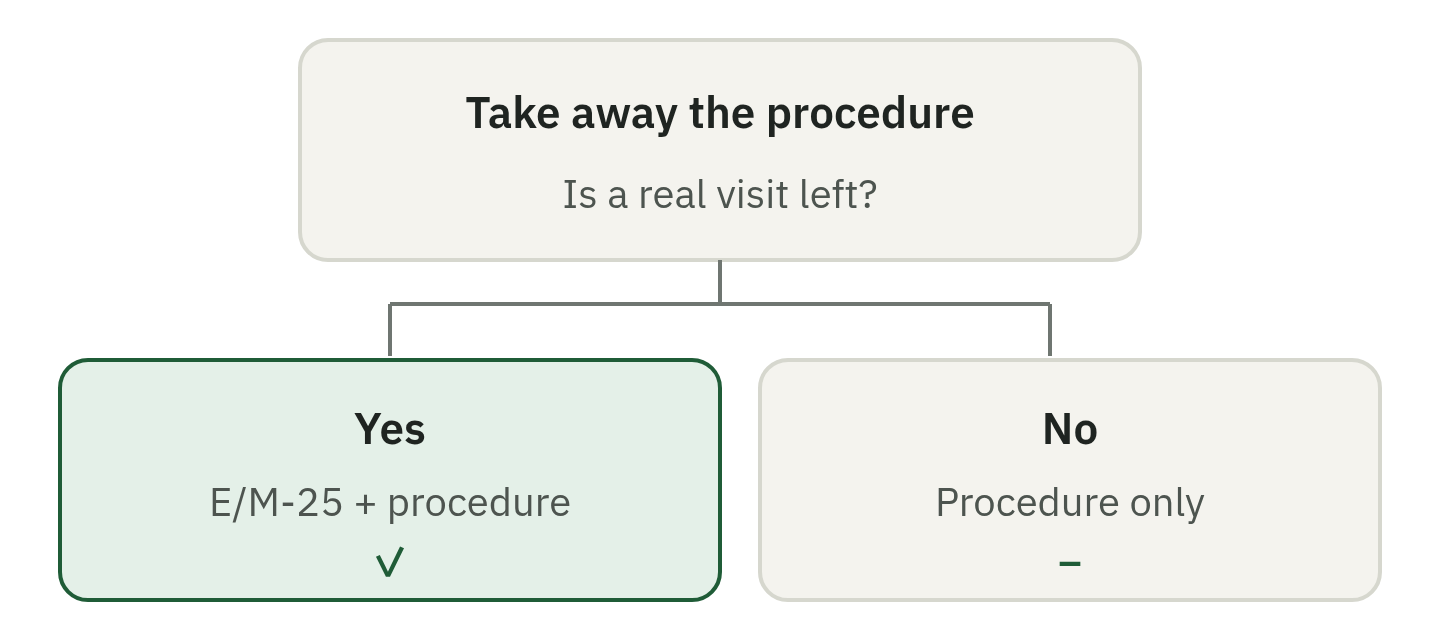
Modifier 25 is not tied to one level. It can go on 99212 or 99215. The visit just has to meet that level's rules, by decision making or total time.[1]
What work is already part of the procedure? #
Every procedure code pays for some work before and after it. You cannot bill a visit for that work. The AMA lists it:[1]
- Reviewing the relevant history
- Checking the area you will treat
- Making and explaining the diagnosis
- Explaining the procedure
- Talking about other options
- Getting consent
- Aftercare advice and follow-up plans
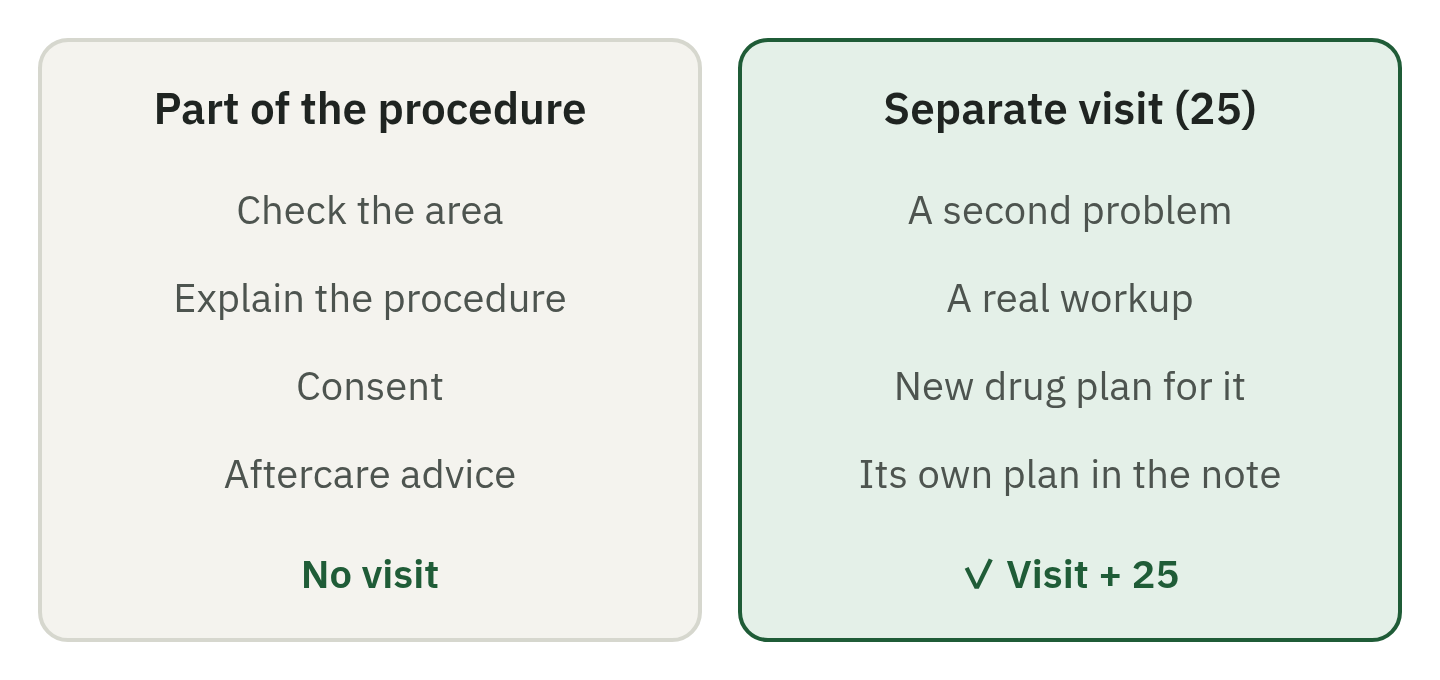
So a short check before a planned injection is not a visit. It is part of the injection.
How do global days change the rule? #
Medicare gives each procedure a global period. It is the number of days of normal follow-up care the procedure already pays for.[3] The global period changes which modifier fits a same-day visit.
- 000 or 010 days: minor procedures. Most office procedures are here. The decision to do one is part of its payment. A separate visit gets modifier 25 only for work beyond that decision.[2]
- 090 days: major surgery. A visit on the day of or the day before, where the clinician decides to do the surgery, gets modifier 57, not 25.[2][3]
- XXX: no global period. Shots, vaccines, ECGs and many tests. A separate visit can get modifier 25. It can share the diagnosis, but it cannot include the work of the service itself.[2]
| Code | What it is (plain words) | Global days |
|---|---|---|
| 20610 | Large joint injection or draining, like a knee, no ultrasound | 000 |
| 11102 | Shave biopsy of one skin lesion | 000 |
| 12001 | Simple repair of a small cut, 2.5 cm or less | 000 |
| 69210 | Removing impacted earwax, one ear | 000 |
| 10060 | Draining a simple skin abscess | 010 |
| 17110 | Removing warts or other benign lesions, up to 14 | 010 |
| 96372 | A shot into a muscle or under the skin | XXX |
| 90471 | Giving one vaccine | XXX |
| 93000 | ECG with reading and report | XXX |
From the October 2026 Medicare fee schedule file (RVU26D).[7] Look up any other code in that file, in the "GLOB DAYS" column.
A note on new patients. Medicare says being new "is not sufficient alone" to bill a visit with a minor procedure.[2] The CPT book points to modifier 57 for a visit that leads to a decision for surgery.[1] Medicare only accepts 57 for 90-day procedures.[3] Other payers vary, so check the payer.
Do you need a different diagnosis for modifier 25? #
No. This is one of the most common myths. Both CMS and the AMA say the visit and the procedure can share a diagnosis.
What matters is the work, not the code. The AMA gives an example. An older man falls and cuts his scalp. He gets a full workup: exam, ECG, x-rays, labs and a head scan. Then the cut is closed. The workup went far beyond the repair, so the visit gets modifier 25, even though one fall caused both.[1] A different diagnosis also does not prove a separate visit. A second problem that was only noted, not worked on, does not count.
Can you bill a wellness visit and a sick visit on the same day? #
Yes, if the problem needed real extra work. The AMA calls the idea that you can't a myth.[4] Bill the wellness visit with no modifier. Bill the problem visit (99202-99215) with modifier 25.[1]
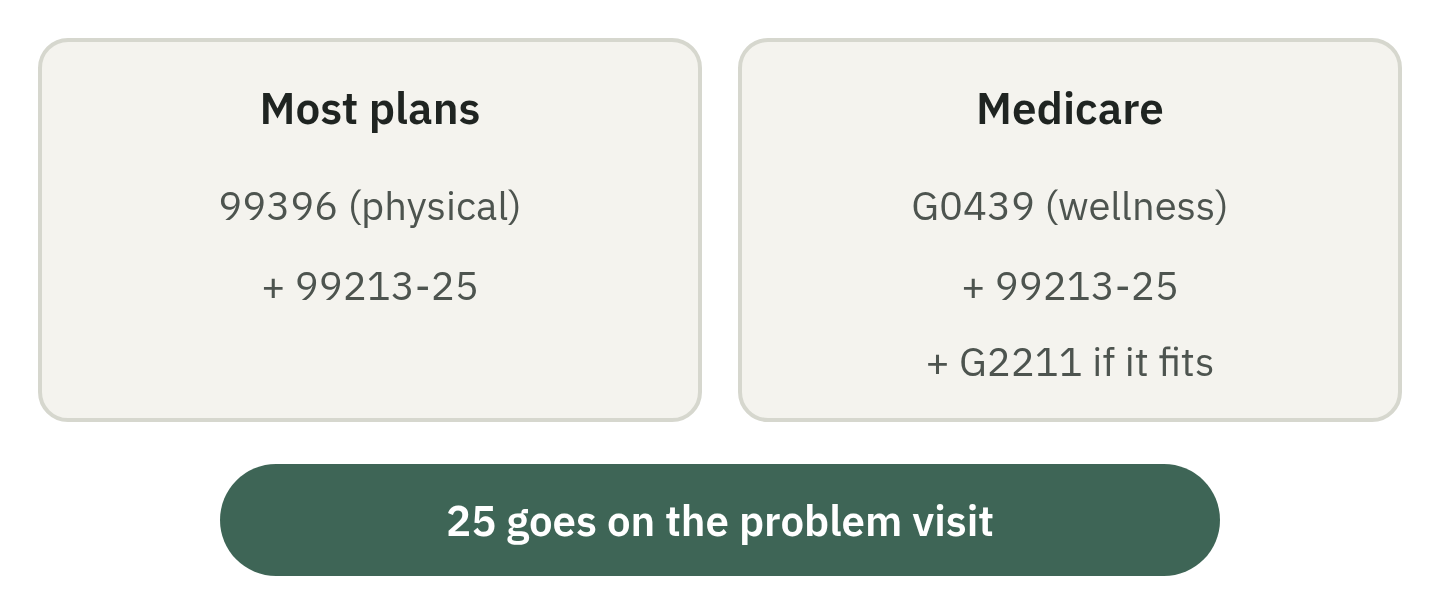
Medicare. CMS may pay for a problem visit on the same day as an annual wellness visit (G0438 or G0439). Report it as 99202-99205 or 99211-99215 with modifier 25.[5] Medicare does not cover the routine physical codes (99381-99397). If a Medicare patient gets one of those with a sick visit, a different rule applies (claims manual, section 30.6.2).[3]
G2211 with modifier 25. Medicare usually denies G2211 when the visit has modifier 25. Since January 1, 2025, it can pay if the other service that day is a wellness visit, a vaccine given, or a Part B preventive service.[6] Our G2211 guide has the details.
Tell the patient. A second code can change what the patient owes. The AMA suggests talking about it at the visit.[4]
Can you use modifier 25 with shots, vaccines and tests? #
Yes, when the visit is separate. These services have no global period (XXX). But the visit cannot count the work of giving the shot, supervising the nurse who gives it, or reading the test.[2]
Watch 99211. Medicare will not pay 99211 (a short visit, often with a nurse) billed with a shot or infusion. If the clinician did a real visit above 99211, bill that level with modifier 25. A different diagnosis is not required.[3]
Modifier 25 vs 59, 57 and 24: which one? #
| Modifier | Goes on | Use it for |
|---|---|---|
| 25 | E/M visit | A separate visit on the same day as a procedure or other service |
| 57 | E/M visit | The visit where the clinician decides to do major surgery, the day of or the day before. Medicare: 90-day procedures only.[3] |
| 24 | E/M visit | A visit during a surgery's follow-up period that is not related to the surgery[2] |
| 59 (or XE, XS, XP, XU) | Procedure, never a visit | Two procedures that are distinct, like different sites or different sessions[2] |
What should the note show? #
You don't send the note with the claim. But the note must back up both the visit and the procedure if anyone asks.[3]
- A separate plan entry for each problem the visit handled.
- A separate procedure note: consent, site, what was done, how it went.
- The visit's own work: the history, exam and decisions for the other problem.
- Level the visit on that work only. Don't count the procedure's own work toward decision making.[2]
- If you use time, leave out the time spent on the procedure. Time on separately billed services does not count.[11]
Worked example 1: a knee injection plus a blood pressure problem #
The patient came in for a planned knee injection. Her blood pressure was also high, and the clinician changed her medicine. We wrote this sample note and ran it through Jentii's free checker.
Reason for Appointment
1. Right knee injection (scheduled)
2. Blood pressure follow-up
History of Present Illness
68-year-old woman with right knee osteoarthritis, here for a planned
steroid injection. Last injection 4 months ago helped. She also
reports home BP readings of 150s-160s/90s for 3 weeks, with mild
morning headaches. Takes lisinopril 10 mg daily. No chest pain, no
shortness of breath, no vision change.
Vital Signs
BP 162/94, repeat 158/92, HR 78
Examination
Right knee: crepitus, mild effusion, no warmth. Heart regular, no
murmur. Lungs clear. No leg edema.
Assessments
1. Primary osteoarthritis, right knee - M17.11
   Notes: Benefit from last injection. Plan injection today.
2. Essential hypertension - I10
   Notes: Not at goal and worse over 3 weeks. Increase lisinopril to
   20 mg daily. BMP in 1 week to check potassium and kidney function.
   Keep a home BP log.
Procedures
Right knee joint injection: Consent obtained. Skin prepped. Injected
triamcinolone 40 mg with 3 mL lidocaine 1% into the right knee by
lateral approach. No complications. Tolerated well.
Treatment
Lisinopril 20 mg tablet, 1 tab by mouth daily, #90
Follow Up
2 weeks for BP check.
Check this note in Jentii
| Code | What it is | Why | Line in the note |
|---|---|---|---|
| 99214-25 | Office visit, moderate | Blood pressure not at goal (moderate problem) plus a prescription change (moderate risk) | Not at goal and worse over 3 weeks. |
| 20610-RT | Knee joint injection | Done at this visit, right side | triamcinolone 40 mg with 3 mL lidocaine 1% into the right knee |
| J3301 × 4 | Triamcinolone, per 10 mg | The drug given: 40 mg is 4 units | triamcinolone 40 mg with 3 mL lidocaine 1% into the right knee |
Result: 99214-25 + 20610-RT + J3301 × 4. Jentii's test: "Take away the procedure: a separate problem was still evaluated and managed, so the visit stands on its own." The blood pressure work alone reaches moderate decision making. Jentii added no G2211. That is right: the 25 here is for a procedure, not a wellness visit.[6]
Worked example 2: a planned injection and nothing else #
Same procedure, but no other problem. This is the visit payers look at most.
Reason for Appointment
1. Right knee injection (scheduled)
History of Present Illness
70-year-old man with right knee osteoarthritis, here for his planned
repeat steroid injection. Last injection 4 months ago helped. Pain is
back to 6/10 with stairs. No fever, no new injury. No other concerns
today.
Vital Signs
BP 128/78, HR 72
Examination
Right knee: crepitus, no effusion, no warmth or redness.
Assessments
1. Primary osteoarthritis, right knee - M17.11
   Notes: Good prior response. Repeat injection today as planned.
Procedures
Right knee joint injection: Risks and benefits reviewed, consent
obtained. Skin prepped. Injected triamcinolone 40 mg with 3 mL
lidocaine 1% into the right knee by lateral approach. No
complications. Tolerated well.
Follow Up
4 months, or sooner if needed.
Check this note in Jentii
| Code | What it is | Why | Line in the note |
|---|---|---|---|
| 20610-RT | Knee joint injection | Done at this visit, right side | into the right knee by lateral approach |
| J3301 × 4 | Triamcinolone, per 10 mg | The drug given: 40 mg is 4 units | lidocaine 1% into the right knee by lateral approach. |
Result: 20610-RT + J3301 × 4, no visit. Jentii returned no office visit code. Take away the injection and nothing is left to bill. The knee exam and the talk about risks are the procedure's own work.[1][2]
Worked example 3: a yearly physical plus shoulder pain #
A commercial patient came in for his physical. He also asked about new shoulder pain. The clinician did a focused exam, started a prescription and ordered therapy.
Reason for Appointment
1. Annual physical
2. Right shoulder pain
History of Present Illness
52-year-old man here for his yearly physical. He also asks about
right shoulder pain for 3 weeks after painting a ceiling. Pain with
reaching overhead and at night. No injury, no numbness, no weakness.
Ibuprofen helps a little.
Preventive
Diet and exercise reviewed. Nonsmoker. 1-2 drinks per week. Colon
cancer screening up to date. Lipid panel and A1c ordered. Flu shot
offered, declined. Counseled on sunscreen and seat belts.
Vital Signs
BP 124/80, HR 70, BMI 27.1
Examination
General exam normal. Right shoulder: pain with abduction past 90
degrees, positive Hawkins and Neer tests, full strength, no
tenderness over the AC joint.
Assessments
1. Encounter for general adult medical exam without abnormal
   findings - Z00.00
2. Impingement syndrome of right shoulder - M75.41
   Notes: Likely rotator cuff tendinopathy. Start naproxen 500 mg
   twice a day with food for 2 weeks. Home shoulder exercises given.
   Refer to physical therapy. X-ray if not better in 6 weeks.
Treatment
Naproxen 500 mg tablet, 1 tab by mouth twice a day with food, #28
Follow Up
6 weeks for shoulder, 1 year for physical.
Check this note in Jentii
| Code | What it is | Why | Line in the note |
|---|---|---|---|
| 99396 | Preventive visit, age 40-64 | Routine physical, established patient. No modifier. | Encounter for general adult medical exam without abnormal findings |
| 99213-25 | Office visit, low | A new, uncomplicated problem (low) plus a prescription (moderate risk) | Start naproxen 500 mg |
Result: 99396 + 99213-25. The shoulder needed its own history, exam and plan. So it is not "trivial." Since a problem was found, Jentii changed the wellness diagnosis from Z00.00 to Z00.01 (exam with abnormal findings). It coded M75.41 for the shoulder. The lipid panel and A1c were part of the physical, so they did not count toward the problem visit.
Worked example 4: a Medicare wellness visit plus a bladder infection #
This is the Medicare version of example 3. It shows when G2211 can go with modifier 25.
Reason for Appointment
1. Annual wellness visit
2. Burning with urination
History of Present Illness
74-year-old woman here for her first Medicare annual wellness visit.
Health risk assessment completed. She also reports 2 days of
burning with urination and urinary frequency. No fever, no back pain,
no vaginal discharge. Takes amlodipine 5 mg daily.
Wellness
Health risk assessment reviewed. Cognitive screen normal. Depression
screen negative. Fall risk low. Written screening schedule given. Advance
care planning offered, she declines today.
Vital Signs
BP 128/76, HR 74, Temp 98.4 F
Examination
No CVA tenderness. Mild suprapubic tenderness.
Labs
Urine dipstick in office: positive leukocytes and nitrites.
Assessments
1. Acute cystitis without hematuria - N30.00
   Notes: Start nitrofurantoin 100 mg twice a day for 5 days. Urine
   culture sent. Call if fever or back pain.
2. Essential hypertension - I10
   Notes: At goal. Continue amlodipine.
Treatment
Nitrofurantoin 100 mg capsule, 1 cap by mouth twice a day, #10
Follow Up
1 year for wellness visit. Call if not better in 3 days.
Check this note in Jentii
| Code | What it is | Why | Line in the note |
|---|---|---|---|
| G0438 | First annual wellness visit | No earlier wellness visit is documented | her first Medicare annual wellness visit |
| 99213-25 | Office visit, low | A new, uncomplicated problem plus a prescription | Start nitrofurantoin 100 mg twice a day for 5 days. |
| G2211 | Visit complexity add-on | Allowed with 25 when the other service is a wellness visit | None |
| 81002 | Urine dipstick, read by hand | Done in the office | Urine dipstick in office |
Result: G0438 + 99213-25 + G2211 + 81002. The bladder infection needed its own exam, test and prescription. CMS lets G2211 go with a 25 visit when the other service is a wellness visit.[6] Jentii also flagged advance care planning for a person to check. It was not coded: care planning was only offered, and she declined.
Five more quick examples #
| Visit | Separate visit? | Bill |
|---|---|---|
| Wart removal planned last month. Wart frozen. Nothing else. | No | 17110 only |
| Cut on the hand repaired. Patient also has new chest pain, worked up with an ECG. | Yes: a second problem | E/M-25 + 12001 + 93000 |
| Diabetes follow-up with a medicine change. Flu shot given. | Yes: the diabetes visit | E/M-25 + vaccine and its admin code |
| Nurse gives a B12 shot. Clinician does not see the patient. | No | 96372 + drug code only. Not 99211 (Medicare). |
| New patient with a skin spot. Clinician looks and does a shave biopsy. Nothing else. | No (Medicare) | 11102 only. Being new is not enough. |
These five are our own analysis using the CMS and AMA rules above.[1][2][3] Payers can differ.
What mistakes cause modifier 25 denials or audits? #
Modifier 25 has been watched for a long time. In a federal review of 2002 Medicare claims, 35% of the modifier 25 claims that were paid did not meet the rules. That came to about $538 million in improper payments.[9] Medicare contractors can also add reviews for clinicians who use it far more than their peers.[3]
- Adding 25 to every visit with a procedure. It only fits when the note shows separate work.
- Billing the decision to do a minor procedure as a visit. That work is already paid.
- Thinking you need a different diagnosis. You don't. A different code also doesn't prove a separate visit.
- Putting 25 on the procedure. It goes on the E/M code only.
- Using 59 on a visit. CMS says 59 is not for E/M services. Use 25.
- Counting the procedure's work toward the visit level. Level the visit on its own work and time.
- Using 25 to get past an edit. CMS says a modifier must not be added "solely to bypass an NCCI PTP edit."[2]
- Adding 25 when nothing else was billed that day. The federal review found this too. It has no purpose.[9]
| Denial | What it says | What to check |
|---|---|---|
| CO-4 | "The procedure code is inconsistent with the modifier used."[8] | Is 25 on the procedure line by mistake? Move it to the E/M line. |
| CO-97 | "The benefit for this service is included in the payment/allowance for another service/procedure that has already been adjudicated."[8] | Was 25 left off? Does the note show separate work? If yes, correct the claim or appeal with the note. If no, the denial is right. |
| G2211 denied | The visit has 25 and the other service was a procedure | Expected. G2211 with 25 is only paid next to a wellness visit, vaccine or Part B preventive service.[6] |
Code what the note shows. If the visit was real and separate, write it so a reader can see it. If it wasn't, bill the procedure alone.
Will modifier 25 change in 2027? #
The rules for using it are not changing. But Medicare has proposed a payment change for 2027. It is not final yet.
Here is the idea. The same clinician (or group) does an office visit and a 0-, 10- or 90-day procedure on the same day. The most expensive service would be paid in full. The others would be paid at 50%.[10] CMS says it proposed something like this for 2019 too, and did not finalize it then.[10]
The fact sheet names 0-, 10- and 90-day procedures. It does not name XXX services like shots and vaccines. The final rule usually comes out in November. We will update this guide when it does.
Questions people ask about modifier 25 #
What is the modifier 25 description? #
Its full name is "Significant, Separately Identifiable Evaluation and Management Service by the Same Physician or Other Qualified Health Care Professional on the Same Day of the Procedure or Other Service." In plain words: a real, separate visit, by the same clinician, on the same day as a procedure or other service.
Does modifier 25 need a different diagnosis? #
No. CMS and the AMA both say the visit and the procedure can share a diagnosis. What counts is the work. The note has to show a visit above and beyond the procedure's usual before-and-after care. A different diagnosis that was only listed, not worked on, does not make a separate visit.
Does modifier 25 go on the procedure or the visit? #
On the visit. Modifier 25 only goes on E/M codes, like 99213-25 or 99214-25. Never put it on the procedure code, the shot, the vaccine or the test. If a payer denies the claim with CO-4, check first whether 25 landed on the wrong line.
What is the difference between modifier 25 and 59? #
Modifier 25 goes on a visit to show it was separate from a procedure that day. Modifier 59, and the X modifiers XE, XS, XP and XU, go on procedures to show two procedures were distinct, like different sites. CMS says 59 should not be used on an E/M visit. For that, use 25.
What is the difference between modifier 25 and 57? #
Both go on visits. Modifier 57 is for the visit where the clinician decides to do surgery, on the day of or the day before. Medicare only takes 57 for 90-day procedures. For minor procedures, Medicare counts the decision as part of the procedure. Modifier 25 is for other separate work.
Can I bill a physical and a sick visit on the same day? #
Yes, if the problem needed real extra work: its own history, exam and decisions. Bill the preventive code with no modifier and the problem visit with modifier 25. A small problem that is only noted, with no extra work, is part of the physical. A second code may change what the patient owes.
Can I bill G2211 with modifier 25? #
Only sometimes. Medicare denies G2211 when the visit has modifier 25. The exception: the other service that day is an annual wellness visit, a vaccine given, or a Part B preventive service. So a visit plus a joint injection gets no G2211. A visit plus a wellness visit can.
Does modifier 25 trigger audits? #
It gets extra attention. A federal review found 35% of paid modifier 25 claims from 2002 did not meet the rules. Medicare contractors can review clinicians who use it much more than their peers. Using it correctly, with a clear note, is the best protection.
Check your own note #
Paste a note into Jentii's free checker. You get the codes, any modifier 25, and the line in the note behind each one. It also runs the "take away the procedure" test for you. Names, dates and IDs are removed on your computer before anything is sent.
Payer rules can differ. When a payer has its own modifier 25 policy, follow it.
Sources
- AMA, Reporting CPT modifier 25 (CPT Assistant) (November 2023)
- CMS, NCCI Policy Manual for Medicare Services, Chapter 1 (revised January 1, 2026)
- CMS, Medicare Claims Processing Manual, Chapter 12 (sections 30.6.2, 30.6.6, 30.6.7, 40.2) (Rev. 13753, May 7, 2026)
- AMA, Debunking regulatory myths: billing preventive and E/M services together (updated December 2, 2025)
- CMS, Medicare wellness visits: annual wellness visit (current)
- CMS, Evaluation and Management Services Guide (MLN006764) (May 2026)
- CMS, 2026 Physician Fee Schedule relative value file RVU26D (global days) (updated August 26, 2026)
- X12, Claim adjustment reason codes (current)
- HHS Office of Inspector General, Use of modifier 25 (OEI-07-03-00470) (November 2005)
- CMS, CY 2027 Physician Fee Schedule proposed rule fact sheet (July 14, 2026)
- AMA, CPT E/M code and guideline changes (time rules) (effective January 1, 2023, current for 2026)
Changes to this guide
- : First published.