99214 vs 99215: MDM and time rules for 2026
Bill 99215 when the visit needs high medical decision making, or the clinician spends at least 40 minutes on the patient that day. Bill 99214 when decision making is moderate, or the time is 30 to 39 minutes. For 99215, two of the three parts of decision making must reach high.
How we made this: Kate wrote this with AI help from the AMA's E/M guidelines and FAQs and the CMS E/M guide. All three worked examples were run through Jentii's free checker on October 27, 2026, and the results are shown as they came out.
What is CPT 99214? #
CPT 99214 is an office visit for an established patient that needs moderate medical decision making. If you pick the level by time, the clinician's total time that day must be at least 30 minutes.[1] The visit also needs a history and exam that fit the problem. But they no longer set the level.[2]
What is CPT 99215? #
CPT 99215 is the top office visit level for an established patient. It needs high medical decision making, or at least 40 minutes of the clinician's total time that day.[1] When time goes well past 40 minutes, you may add a prolonged time code. Most payers use 99417. Medicare uses G2212.[2][5]
Both boxes are our plain-language summaries. The AMA owns the official CPT wording, linked under Sources.
What is the difference between 99214 and 99215? #
Both codes are for an established patient: someone a clinician of the same specialty in your group has seen in the last three years.[2] The difference is how hard the decisions were, or how much time the visit took.
| 99214 | 99215 | |
|---|---|---|
| Decision making | Moderate | High |
| Or total time that day | At least 30 minutes | At least 40 minutes |
| Problems (one of these) | 1 chronic illness that is worse or not at goal, or 2 or more stable chronic illnesses, or 1 new problem with an unclear outcome, or 1 serious acute illness, or 1 complicated injury | 1 chronic illness with a severe flare, a big decline or severe side effects, or 1 illness or injury that threatens life or a body function soon without treatment |
| Data | 1 of 3 groups: 3 items (outside notes, test results, tests ordered, history from someone else), or reading a test yourself, or talking with an outside doctor | 2 of the same 3 groups |
| Risk (examples) | Starting, changing or continuing a prescription; minor surgery with risk factors; care limited by money, housing or transport | A drug that needs intensive lab checks for harm; a decision about hospital care; major surgery with risk factors; emergency major surgery; a DNR or less aggressive care |
| Prolonged time add-on | None | 99417 from 55 minutes (CPT), or G2212 from 69 minutes (Medicare) |
Our summary of the AMA's decision-making table and CMS's prolonged time table.[3][5]
How does the 2-of-3 rule decide 99215? #
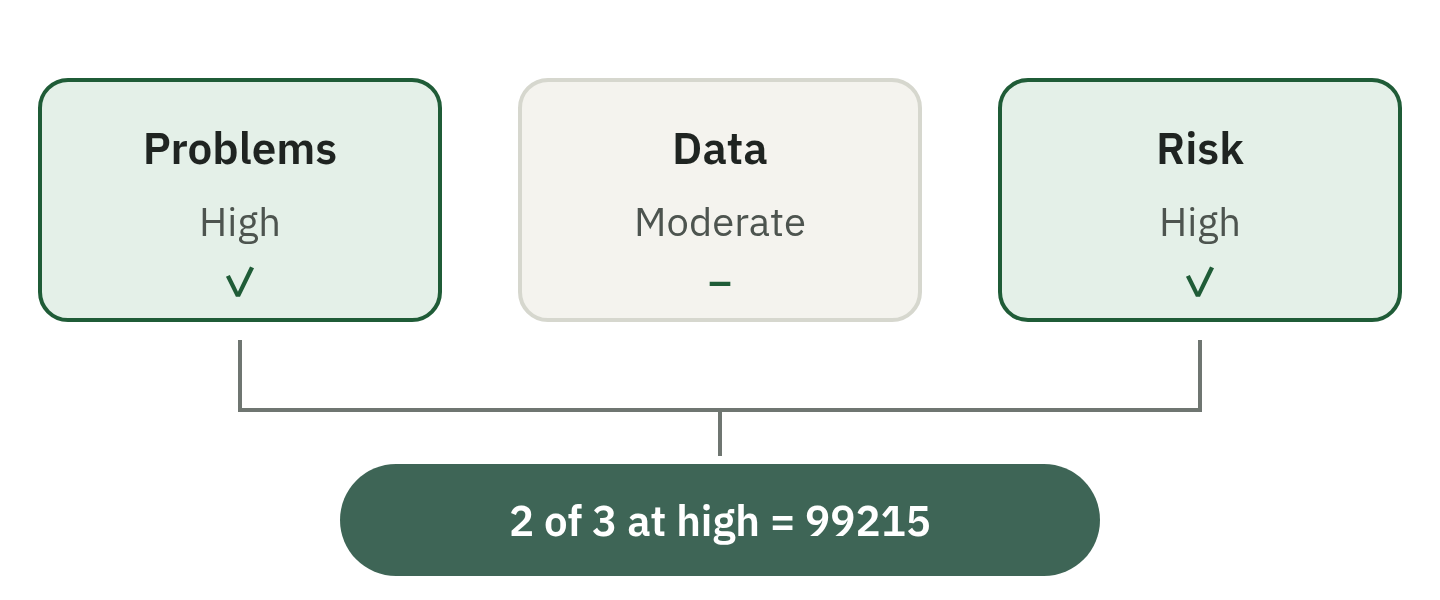
Medical decision making (MDM) has three parts: problems, data and risk. Each part gets a level. The visit takes the level that two of the three reach.
So one high part is not enough. A heart failure flare with only moderate data and moderate risk is still 99214. The AMA says it plainly: two of the three must be high for the visit to be high.[4]
Which problems count as high? #
Only two kinds of problems are high:
- A chronic illness with a severe flare, a big decline, or severe side effects of treatment. The AMA means a flare with real risk that "may require escalation in level of care," like a hospital stay.[2]
- An illness or injury that threatens life or a body function. The threat must be "in the near term without treatment."[2] Chest pain that could be a heart attack is one example.
Symptoms can count as high even if the final answer turns out to be minor. What matters is what the clinician was ruling out, and whether the workup matched that worry.[2]
Many problems are not the same as high problems. Three stable chronic illnesses are still moderate on the table. Several smaller problems can raise the risk when they interact. But the note has to show how.[2]
So the clinician has to write it down. "Severe flare" or "worsening despite treatment" in the assessment tells the reader what the clinician saw.
What data counts as extensive? #
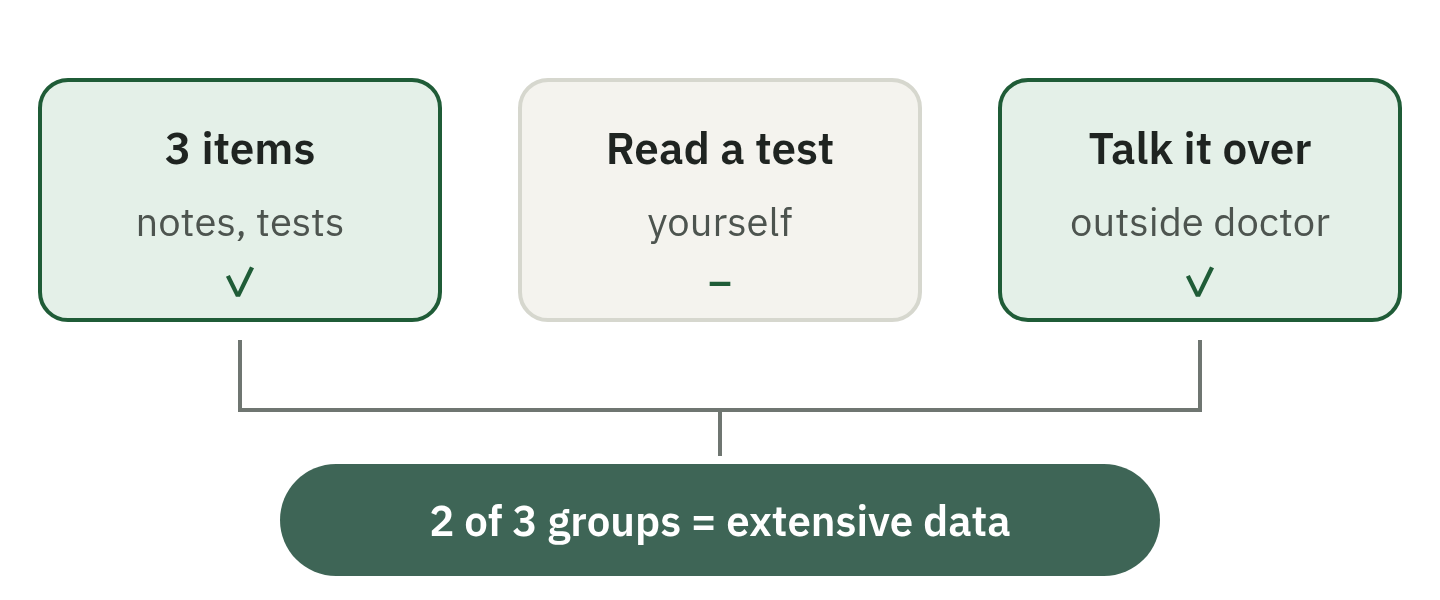
Data has three groups. Moderate data needs one group. Extensive (high) data needs two.[3]
- Three items, in any mix: each outside note you review (one per source), each unique test result you review, each unique test you order, or history from someone else (like a family member).
- Reading a test yourself that someone else will bill, like looking at an ECG tracing and writing what you see.
- Talking with an outside doctor or other appropriate source about the plan. It must be a real back-and-forth, not a note sent over.[2]
Do not count a test twice. Ordering a test includes reviewing its result later. A lab panel, like a CBC, is one test. And if you bill the reading of a test (like an ECG), that reading does not count again here.[2]
What makes risk high? #
Risk is about the plan. The AMA lists these as examples of high risk:[3]
- A drug that needs intensive monitoring for harm
- A decision about hospital care
- Planned major surgery when the patient has risk factors
- Emergency major surgery
- A decision for a DNR, or for less aggressive care because the outlook is poor
A decision about hospital care counts even when the patient does not go. The AMA says options "considered but not selected" after shared decision making still count.[2] Write down the options, the risks you explained, and what the patient chose.
Intensive monitoring has a strict meaning. The drug can cause serious harm, and you check for that harm with a lab, test or imaging. Long-term checks must happen at least every three months. "Monitoring by history or examination does not qualify."[2]
In plain words: sugar checks for a patient on insulin do not count, unless severe low blood sugar is a real worry right now. Yearly kidney labs for a patient on a diuretic do not count either.
How does time work for 99214 and 99215? #
You can pick the level by time instead of decision making. Count the clinician's own total time on the date of the visit, in the room and out of it.[2]
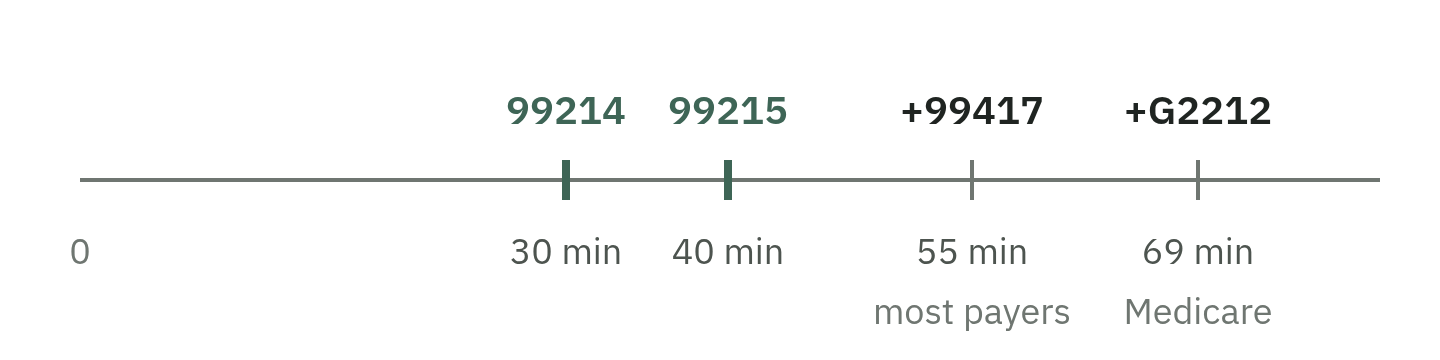
CPT lists the time for each level as a minimum that "must be met or exceeded."[1] So 99214 needs 30 minutes or more, and 99215 needs 40 minutes or more.
What counts: getting ready (like reviewing outside results), the history and exam, counseling, ordering tests or drugs, talking with other clinicians, and writing the note. All of it must be on the same date.[2]
What does not count: time your nurse or MA spends, travel, time on another day, and time on anything you bill on its own, like a procedure.[2]
Write the total in the note, for example: "Total time on the date of the visit: 42 minutes." A short list of what the time was spent on helps too.
When can you add 99417 or G2212? #
A prolonged time code goes on top of 99215 when the visit runs long. It only works when you picked 99215 by time. You cannot add it to 99214, and you cannot add it when the level came from decision making.[2]
Medicare does not use 99417. It uses its own code, G2212, and counts from the top of the 99215 range, 54 minutes.[5] So the first unit starts later.
| Most payers (CPT 99417) | Medicare (G2212) | |
|---|---|---|
| 99215 alone | 40 to 54 minutes | 40 to 68 minutes |
| 1 unit | 55 to 69 minutes | 69 to 83 minutes |
| 2 units | 70 to 84 minutes | 84 to 98 minutes |
| 3 or more units | 85 minutes or more | 99 minutes or more |
| Each unit is | 15 more full minutes | 15 more full minutes |
From the AMA's 99417 table and the CMS G2212 table.[2][5] Some other payers follow Medicare. Check each payer's policy.
Should you pick 99215 by decision making or by time? #
Use whichever one the note supports best. You can use either one for any office visit. The AMA puts it this way:
A fast visit for a dangerous problem fits decision making. A long visit with a lot of counseling fits time. Either way, the note has to show it. Do not write a time you did not spend.
Worked example 1: a heart failure flare that is 99215 #
We wrote this sample note and ran it through Jentii's free checker. Here is the note and exactly what came back.
Reason for Appointment
1. Swelling and shortness of breath
History of Present Illness
76-year-old man with heart failure (EF 30%). Weight up 7 lb in 5
days. Short of breath walking to the mailbox. Needs 3 pillows to
sleep, new this week. Takes furosemide 40 mg daily, metoprolol
succinate 50 mg daily and lisinopril 10 mg daily. Reviewed his
cardiology clinic note from 3 weeks ago.
Vital Signs
BP 138/86, HR 96, RR 22, SpO2 91% on room air, Wt 212 lb (was 205)
Examination
Crackles at both lung bases. JVD to the angle of the jaw. 2+ pitting
edema to both knees.
Assessments
1. Acute on chronic systolic heart failure - I50.23
   Notes: Severe flare with fluid overload and low oxygen.
   Advised he be admitted today. He declines after we talked
   through the risks. His daughter will stay with him.
   Increase furosemide to 80 mg twice a day. BMP and BNP today.
   Called his cardiologist, who agrees with the plan and will see
   him in 2 days.
Treatment
Furosemide 80 mg tablet, 1 tab by mouth twice a day, #60
Follow Up
2 days. Go to the ED for chest pain or worse breathing.
Check this note in Jentii
| Part | Level | Why | Line in the note |
|---|---|---|---|
| Problems | High | A chronic illness with a severe flare. | Severe flare with fluid overload and low oxygen. |
| Data | Extensive | Two tests ordered and an outside note reviewed (three items), plus a talk with his cardiologist. | BMP and BNP today. |
| Risk | High | A decision about hospital care, even though he chose to stay home. | Advised he be admitted today. |
Result: 99215. All three parts are high, and only two were needed. No time is written, so the level comes from decision making. Jentii also coded I50.23 (acute on chronic systolic heart failure) and, because the patient has Medicare, the add-on G2211. See our G2211 guide for when that add-on is paid.
Worked example 2: three problems that are still 99214 #
This visit covers three chronic illnesses. It feels busy. But none of the problems is severe, and the plan is a routine prescription change.
Reason for Appointment
1. Diabetes follow-up
2. Blood pressure
3. Cholesterol
History of Present Illness
64-year-old woman here for her 3-month visit. Her A1c from last week
is 8.4%, up from 7.6%. Her goal is under 7%. No low sugars. Home blood
pressure runs 120s/70s. Takes metformin 1000 mg twice a day,
lisinopril 20 mg daily and atorvastatin 40 mg daily. No side effects.
Vital Signs
BP 124/76, HR 70, Wt 176 lb, BMI 30.1
Assessments
1. Type 2 diabetes mellitus with hyperglycemia - E11.65
   Notes: Above goal and rising. Add glipizide 5 mg daily. Reviewed
   signs of low blood sugar. Recheck A1c in 3 months.
2. Essential hypertension - I10
   Notes: At goal. Continue lisinopril 20 mg daily.
3. Hyperlipidemia, unspecified - E78.5
   Notes: LDL 92 in the spring, at goal. Continue atorvastatin 40 mg daily.
Treatment
Glipizide 5 mg tablet, 1 tab by mouth daily with breakfast, #90
Follow Up
3 months
Check this note in Jentii
| Part | Level | Why | Line in the note |
|---|---|---|---|
| Problems | Moderate | Diabetes is not at goal. Blood pressure and cholesterol are stable. None is a severe flare. | Above goal and rising. |
| Data | Minimal | One outside result reviewed. That is not enough for limited data, let alone extensive. | None |
| Risk | Moderate | Prescription drug management. | Add glipizide 5 mg daily. |
Result: 99214. Jentii's note on this visit: "Not 99215: that needs two parts at high or 40 minutes of total time. None are." It also coded E11.65, I10, E78.5 and Z79.84 (long-term use of oral diabetes drugs).
Worked example 3: a long memory visit that is 99215 by time #
This visit has only moderate decision making. But the clinician spent 62 minutes on it that day, and wrote that down.
Reason for Appointment
1. Memory problems
History of Present Illness
78-year-old woman, a patient of this practice for 10 years, here
with her daughter for 8 months of memory loss. She has missed bills
and got lost driving to church.
Daughter gives most of the history because the patient cannot recall
recent events. Reviewed outside neurology consult note and brain MRI
report from last month.
Examination
Alert. Mini-Cog 1 of 5. Normal gait. No focal weakness.
Assessments
1. Mild cognitive impairment of uncertain cause - G31.84
   Notes: Discussed safety. Advised she stop driving until her
   neurology follow-up. Ordered B12 and TSH. Gave the daughter
   caregiver resources and a home safety checklist.
Total time on the date of the visit: 62 minutes. This includes
reviewing the outside notes and MRI report before the visit, history
from the daughter, the exam, counseling, care planning and writing
this note. Time for separately billed services is not included.
Follow Up
6 weeks
Check this note in Jentii
| Part | Level | Why | Line in the note |
|---|---|---|---|
| Problems | Moderate | A new problem that is being worked up. | Mild cognitive impairment of uncertain cause |
| Data | Moderate | Tests ordered, outside records and results reviewed, and history from her daughter. That is one group only. | Reviewed outside neurology consult note and brain MRI |
| Risk | Low | Low-risk tests. | Ordered B12 and TSH. |
| Time | 62 minutes | 40 minutes or more supports 99215 on its own. | Total time on the date of the visit: 62 minutes |
Result: 99215, picked by time. Jentii's note: "Decision making alone would be moderate." The patient has Medicare, so Jentii added G2211 but no G2212. That is right: G2212 starts at 69 minutes.[5]
We ran the same note again as a commercial plan that follows CPT. That time Jentii returned 99215 + 99417 × 1, because 62 minutes is past 55.[2] Same visit, different add-on, only because of the payer.
Four more quick examples #
| Visit | Problems | Data | Risk | Code |
|---|---|---|---|---|
| Chest pain that could be a heart attack. Sent to the ER by ambulance. | High (threat to life) | Minimal | High (hospital care) | 99215 |
| Type 2 diabetes on insulin, sugars high. Insulin dose raised. | Moderate (not at goal) | Minimal | Moderate (sugar checks are not intensive monitoring) | 99214 |
| Stable rheumatoid arthritis on methotrexate. CBC and liver tests every 3 months reviewed. No change. | Low (1 stable chronic) | Limited (2 results) | High (intensive monitoring) | 99213 |
| Low decision making, but 45 minutes of counseling and planning that day, written in the note. | Low | Limited | Low | 99215 (by time) |
The third visit has high risk but is only 99213. One high part does not lift the visit. Problems and data both sit at low, so the level is low. These four are our own analysis using the AMA table.[3]
What mistakes cause 99215 denials or audits? #
- Counting many problems as high. A long problem list is not a severe problem. See worked example 2.
- One high part. High risk alone, like a drug that needs lab checks, does not make 99215.
- Writing "admission discussed" with nothing else. Show the options, the risks and what the patient chose.
- Counting staff time. Only the billing clinician's own time counts.[2]
- Adding 99417 to a visit picked by decision making. Prolonged time only goes with a level picked by time.
- Using 99417 for Medicare. Medicare wants G2212, starting at 69 minutes.[5]
- Leaving out the total time. If the note does not say it, the level has to come from decision making.
- Copy-paste templates. The same "high risk" line on every note, with no real decision that day, is an audit red flag.
Code what the note shows. If the work was high, write it so a reader can see it. If it was moderate, 99214 is the right code.
Questions people ask about 99214 and 99215 #
What is the 99214 time requirement in 2026? #
For 99214, the clinician's total time on the date of the visit must be at least 30 minutes. That includes time before and after the patient is in the room, like reviewing results and writing the note. It does not include nurse or MA time. Write the total minutes in the note.
What is the 99215 time requirement in 2026? #
For 99215, total time on the date of the visit must be at least 40 minutes. It counts the clinician's own work that day, in and out of the room. Past 55 minutes, most payers allow 99417. Medicare uses G2212, starting at 69 minutes. Each extra unit needs 15 more full minutes.
Can I bill 99417 with 99214? #
No. Prolonged time codes only go with the top level, 99215 for established patients. If a visit took 55 minutes, you would bill 99215 by time and then add 99417. You also need to pick the level by time, not by decision making, to use 99417 at all.
Does Medicare pay 99417? #
No. Medicare uses its own code, G2212, for prolonged office visits. CMS counts from the top of the 99215 range, so the first G2212 unit starts at 69 minutes of total time. Some Medicare Advantage and other plans may follow Medicare or CPT. Check each plan's policy before you bill.
Does a decision about the hospital always make a visit 99215? #
No. A decision about hospital care makes risk high. That is only one of three parts. You also need high problems or extensive data for 99215. In practice, a patient sick enough to need the hospital often has a high problem too. The note has to show both.
Does a long note or a full exam support 99215? #
No. Since 2021, history and exam do not set the office visit level. They only need to fit the visit. The level comes from decision making or total time. A long note with copied-in text can even hurt you in an audit, because it hides what was really done that day.
Can my nurse's or MA's time count toward 99215? #
No. Only the billing clinician's own time counts toward 99214 or 99215. Staff time does not count, even if they spent a long time with the patient. For a visit shared between a doctor and an NP or PA, the rules for who bills are different. Check the CMS split visit rules.
Will 99214 and 99215 change in 2027? #
CPT 2027 takes effect January 1, 2027. Medicare's 2027 payment rule was still a proposal when we checked. It includes changes to G2211 and to visits on the same day as some procedures.[6] We will update this guide when the final rules are out.
Check your own note #
Paste a note into Jentii's free checker. You get the level and the grid above for that note, with the line behind each part. It also shows the time rule and any prolonged time code. Names, dates and IDs are removed on your computer before anything is sent.
Payer rules can differ. When a payer has its own policy, follow it.
Sources
- AMA, CPT Assistant special edition: prior authorization work within office visits, with the 99213–99215 descriptors and their time (October 2024)
- AMA, CPT E/M code and guideline changes (decision making definitions, time, 99417) (effective January 1, 2023, current for 2026)
- AMA, Table 2: levels of medical decision making (current)
- AMA, CPT E/M revisions FAQs (updated January 26, 2026)
- CMS, Evaluation and Management Services Guide (MLN006764) (May 2026)
- CMS, CY 2027 Physician Fee Schedule proposed rule fact sheet (July 14, 2026)
Changes to this guide
- : First published.
- : Added a link to the modifier 25 guide.